
Concrete Contractor Insurance: What It Actually Costs and Covers
Kenneth Schaub, Owner & Licensed Insurance Advisor
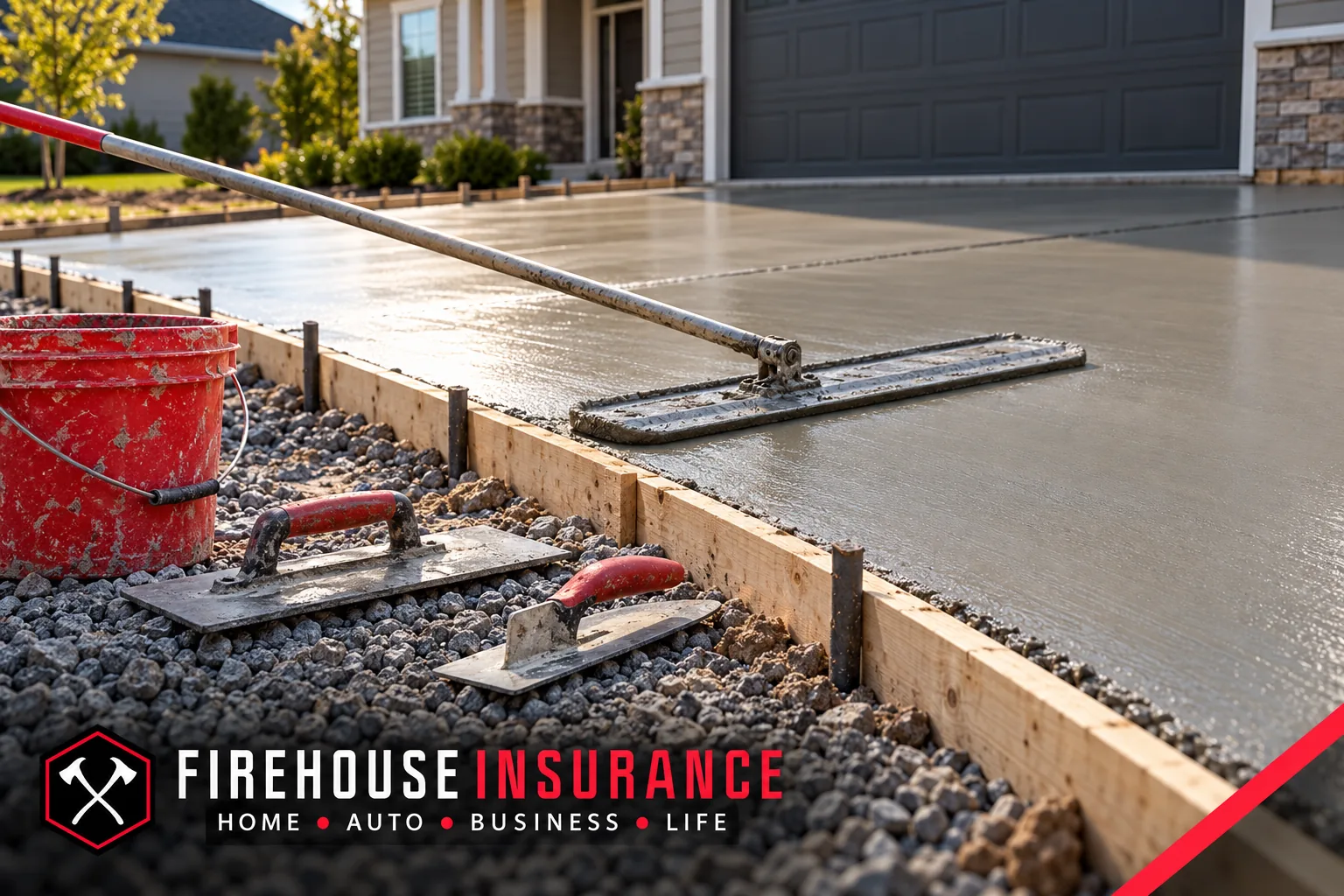
General liability insurance for a concrete contractor typically costs around $1,218 a year on average, with smaller operators often paying less.
How much does general liability insurance cost for a concrete contractor?
- Average: around $102/month ($1,218/year)
- Small operators: roughly $75 to $105 a month ($600-$1,260/year)
- Broader range: $68 to $119 a month depending on revenue, crew size, and whether you do flatwork or structural/foundation work
$1 million per occurrence / $2 million aggregate is the standard baseline GCs require, typically with completed-operations coverage and an additional-insured endorsement built into the contract.
Why are workers' comp rates so different for concrete work?
Concrete workers' comp class codes carry some of the highest rates in construction, and the difference between flatwork and structural work is real. In California, code 5213 (flatwork/cement) ranges $5.68 to $18.92 per $100 of payroll, while code 5201 can run up to $33.36. Florida's flatwork cement code sits at $3.873 per $100. The exact classification of your work materially changes your premium, it's worth confirming you're classified correctly, not just accepting whatever code your carrier defaults to.
What happens if a defect doesn't show up for years?
This is the single most important coverage concept in concrete work: most states have a statute of repose, distinct from a statute of limitations, that caps your liability window at a fixed number of years from substantial completion, regardless of when a defect is actually discovered. More than 30 states have one. Concrete cracking, spalling, and settling often don't surface until well after a slab or foundation is already in service, which is exactly why completed-operations coverage matters, it's the product that bridges the gap between when you finish a job and when a problem might actually appear.
What does OSHA's silica rule require, and why does it matter for insurance?
OSHA's 2016 silica rule (enforceable since September 2017) cut the permissible exposure limit from 250 to 50 micrograms per cubic meter averaged over an 8-hour shift. OSHA estimated industry-wide compliance costs at roughly $1.03 billion a year, with the construction sector bearing about $659 million of that, though the Construction Industry Safety Coalition pegs the real-world cost significantly higher, around $4.9 billion a year. Not using wet cutting or vacuum dust collection per OSHA's requirements is both a citation risk and a latent bodily-injury exposure (silicosis), the kind of long-tail claim that can surface years after exposure, similar to the defect-discovery problem above.
What bonding applies to concrete contractors?
19 states require a state-level contractor license bond. California's flat $25,000 bond applies to every classification through the CSLB. Florida requires a minimum $5,000 surety bond under state statute. Several states, Texas, Colorado, and Illinois among them, push bonding decisions down to the city or county level, which means requirements can vary even within a single state.
See full coverage details for Concrete Contractor Insurance, or start a free quote to compare your own numbers.
Frequently asked questions
Do I need insurance for cracks or defects that show up years after the pour?
Yes, this is exactly what completed-operations coverage is for. Given that most states' statute of repose runs on a fixed clock from completion rather than discovery, having this coverage in place before a claim arises is essential, you can't add it retroactively once a defect surfaces.
What's the workers' comp class code for concrete contractors?
It depends on the specific work, flatwork and structural/foundation work are classified and rated differently, sometimes by a factor of 3-5x. Confirm your crew is classified correctly, since misclassification affects both cost and claims handling.
Does insurance cover a sidewalk or driveway that cracks after installation?
It can, under completed-operations coverage, but normal settling and minor cracking are often treated differently than a genuine structural defect. Document your pour specifications and curing process, it matters if a dispute ever arises.
Ready to see your real rate?
Get My Quote